OpenAI’s Start of the Robotics Era
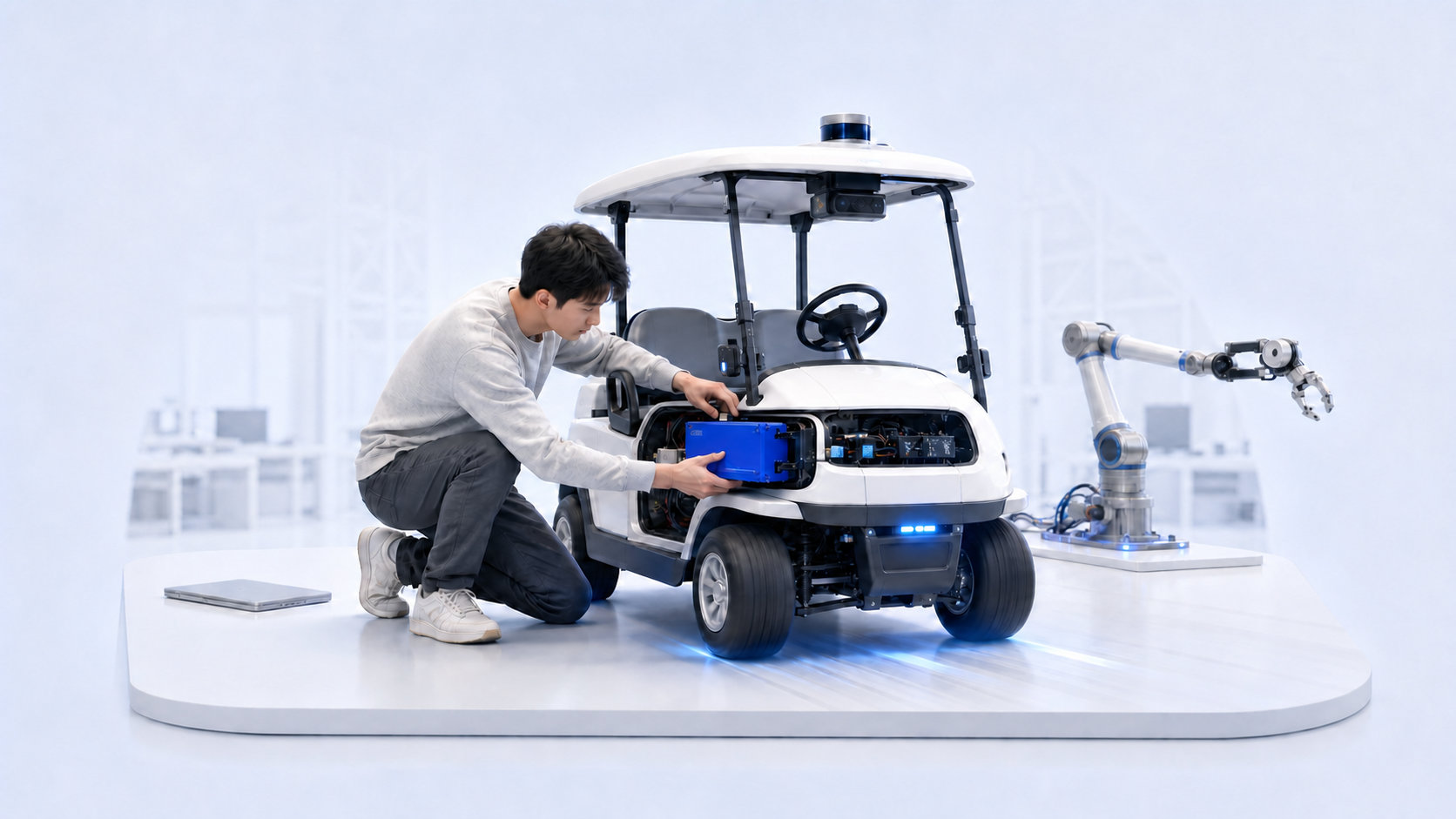
A handful of Stanford students spent a month building a self-driving golf cart, and OpenAI shared the story across its TikTok and Instagram accounts like a proud campus update. The students said they had always used Codex, the company’s coding tool, to vibe-code, meaning they described what they wanted in plain language and let the tool write the code. They had never used it to build something physical before. This time they set it to designing mechanical parts and testing where they would fail, wiring circuit diagrams, and tuning the driving software that let the cart steer itself around campus. Days later, the story read differently.
Sam Altman, the company’s chief executive, posted that OpenAI Robotics is hiring “exceptional full-stack hardware, ops, systems, and ML engineers to help us program and manufacture robots that are useful for society.” The post described its near-term focus as robots built to support the skilled workers who build data centers and power grids, with a longer-term goal of “everyone having a personal robot doing anything they need.” Placed next to the golf cart story, the timing stops looking like a coincidence. The cart worked as proof, delivered at exactly the moment the company needed it, that the same tools people use to write code already design and run a physical machine.
That bet on physical products reaches beyond robots. The company is separately building a personal device with Jony Ive, the designer behind the iPhone, meant to put AI into something people carry every day. Robots extend the same idea into heavier equipment: machines that build things instead of fitting in a pocket.
OpenAI already made one run at exactly that kind of machine. In 2019, a robotic hand that the company had been training since 2017 solved a Rubik’s Cube one-handed, a project engineers there called a milestone toward general-purpose robots. Two years later, in 2021, it shut the entire robotics team down.
Co-founder Ilya Sutskever explained why on the Dwarkesh Podcast. “Back then, it really wasn’t possible to continue working in robotics because there was so little data,” he said. “If you wanted to work on robotics, you needed to become a robotics company.” Running even a hundred robots was already a giant operation, he said, and it still would not produce enough data to train a model. Progress at OpenAI had always come from combining computing power with large amounts of data. For robots, in his words, there was “no path forward.”
Data availability has changed since then. Dedicated robotics data pipelines have emerged. So-called world models, software trained to predict how the physical world behaves, have also matured, along with vision systems capable of learning from real surroundings instead of simulation alone. Instead of needing a fleet of company-owned robots to generate that data, even a small project now draws on systems nobody at the company had to build from scratch. The Stanford cart ran on exactly that combination, an open-source driving system paired with a coding tool, tuned against real campus roads rather than a simulated one. The missing ingredient Sutskever described is the one five students had working within a month.
Seen against that history, the golf cart demo reads as a job interview conducted in public. The students did not pitch an idea. They arrived with a finished machine instead. Its mechanical design, wiring, and driving software were largely handled by the same tools the company is now staffing a division around. Altman runs a company nearing a trillion dollars in value. Giving personal attention to a student side project takes real notice, and here it reads as recognition that this one already worked as a recruiting pitch.
There is a caveat worth keeping close here, courtesy of Sutskever himself. He described a possible path forward, but with a warning. Building it would mean committing to thousands, even hundreds of thousands, of robots, and gradually collecting data as they went. That kind of commitment, he said, is work for people willing to solve the physical and logistical problems that come with machines instead of software. OpenAI spent years making chat software look like the whole story. Its hiring push now says the harder, physical version of that same commitment is the part still being built.
Sources
TikTok, OpenAI’s Stanford golf cart post — tiktok.com
X, Sam Altman on OpenAI Robotics hiring — x.com
Built In, OpenAI’s New Device: What We Know So Far — builtin.com
OpenAI, Solving Rubik’s Cube with a robot hand — openai.com
TechCrunch, The Anthropic-Physical Intelligence rumor roiling AI Twitter — techcrunch.com
Dwarkesh Podcast, Ilya Sutskever on Building AGI, Alignment, and Future Models — dwarkesh.com